Knowledge, Technology
Does Aluminum 5083 Corrode? Scientific Analysis in Marine and Industrial Environments
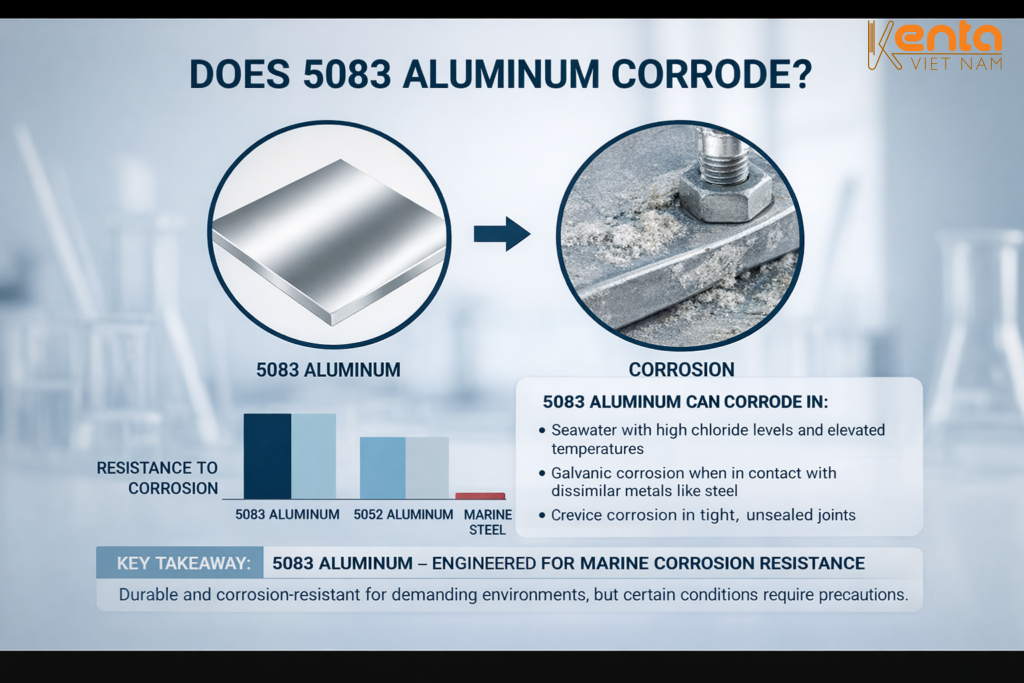
Does Aluminum 5083 corrode?" is a question frequently asked by many engineers and shipyards when selecting materials for harsh environments. In conditions of seawater, high humidity, and continuous electrochemical impact, Aluminum 5083 is still considered an aluminum alloy with superior corrosion resistance. Understanding the nature of 5083 aluminum corrosion correctly helps businesses use materials more efficiently and sustainably.
The Nature of 5083 Aluminum Corrosion
Aluminum 5083 is an aluminum-magnesium alloy belonging to the marine aluminum group, developed to perform stably in saltwater environments. Unlike carbon steel, Aluminum 5083 does not rust red but forms a natural aluminum oxide layer on its surface.
This oxide layer is very durable, adheres tightly, and can self-regenerate when the surface is lightly scratched. This mechanism significantly limits the corrosion process from penetrating deep into the metal.
Does Aluminum 5083 corrode in marine environments?
Saltwater corrosion resistance. Scientifically, Aluminum 5083 can still experience surface corrosion under extreme conditions. However, this corrosion occurs very slowly and is usually limited to the outermost layer, not seriously affecting the structure.
In marine environments, where chloride ions are the primary corrosive agent, Aluminum 5083 shows much better resistance to pitting and crevice corrosion than common aluminum types. This is why this alloy is widely used in shipbuilding, high-speed vessels, and offshore structures.
The role of magnesium in limiting corrosion. The high magnesium content in Aluminum 5083 helps stabilize the crystal structure and reduces the formation of localized electrochemical cells on the metal surface. This slows down the electrochemical corrosion process, which is the main cause of material lifespan reduction in marine environments.
As a result, Aluminum 5083 not only resists corrosion well but also maintains its mechanical strength for a long time.
Under what conditions can Aluminum 5083 still corrode?
Influence of environment and structural design. Aluminum 5083 may show signs of corrosion if it operates in environments with stagnant seawater, poor circulation, or prolonged salt accumulation. Narrow gaps, sealed joints, or surfaces not regularly cleaned are often more prone to localized corrosion.
However, under proper technical design and operation, this level is entirely within the permissible limits of international marine standards.
Material quality and supply source. A very important factor determining whether Aluminum 5083 corrodes is the quality of the input material. Aluminum that does not meet the correct alloy composition or is not inspected according to marine standards is at risk of premature and uneven corrosion.
Kenta supplies Aluminum 5083 with full international certifications such as BV, Lloyd, and ABS, ensuring the material precisely meets the technical requirements for shipbuilding and marine construction.
Comparison of Aluminum 5083's corrosion resistance with other materials
Compared to carbon steel, Aluminum 5083 has a clear advantage in corrosion resistance in saltwater environments, even without a thick protective coating. When compared to some common aluminum alloys, Aluminum 5083 still exhibits higher stability and less degradation over time.
This characteristic makes Aluminum 5083 a long-term material choice, reducing maintenance and repair costs throughout the project's lifespan.
Kenta's role in ensuring the durability and corrosion resistance of Aluminum 5083
Kenta not only supplies materials but also controls the entire supply chain from import, warehousing to delivery. This ensures that Aluminum 5083 is always stored under appropriate conditions, minimizing the risk of surface contamination before use.
With a system of marine aluminum warehouses and experience serving large shipyards, Kenta ensures that each batch of aluminum meets the requirements for durability, corrosion resistance, and uniformity.
Delivery capacity and regional market service
In addition to the domestic market, Kenta also supplies Aluminum 5083 for many projects in the Southeast Asian region.A flexible logistics system helps optimize transportation costs, ensure progress, and maintain the quality of goods.
The ability to deliver throughout Southeast Asia at low cost makes Kenta a trusted partner for many factories, shipyards, and heavy industrial enterprises.
Whether aluminum 5083 corrodes is a question that needs to be viewed with scientific accuracy. In reality, aluminum 5083 can withstand very low levels of corrosion under harsh conditions, but it does not rust and does not severely degrade its structure when used according to proper standards. With internationally certified aluminum sources, complete with BV, Lloyd, and ABS certificates, and extensive delivery capabilities across Southeast Asia, Kenta provides a sustainable, safe, and effective aluminum 5083 solution for marine and industrial projects.
————
KENTA VIETNAM – QUALITY BUILDS TRUST
 Main office: No. 22, Phung Cong service area, Phung Cong Commune, Hung Yen province
 Warehouse No. 1: Ngo Yen Hamlet, Hong An Ward, Hai Phong City (at the foot of Kien Bridge)
Warehouse No. 2: No. 22, Phung Cong service area, Phung Cong Commune, Hung Yen province
 Phone: 0972 887 106 – 0961 909 992
 Email: contact@kentavietnam.com
 Website: kentavietnam.com